Listen to this guide

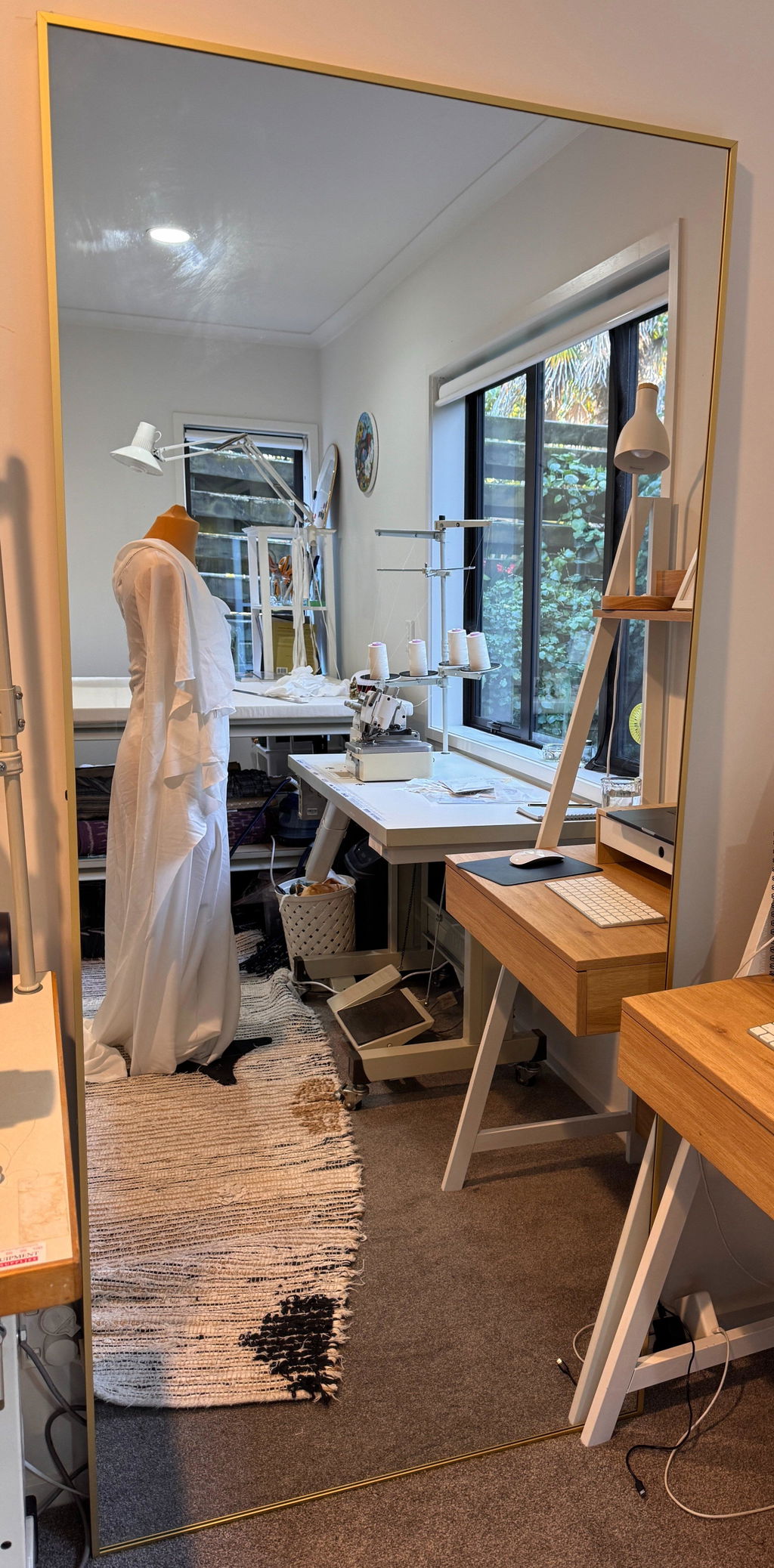
Size up to a large floor mirror when your wall and your ceiling can carry it — roughly a 2.6m stud or higher, a clear wall at least 30cm wider than the mirror, and a floor that can take a heavy leaner that you do not plan to move again. The standard NZ full length floor mirror is 180cm tall by 70 to 80cm wide, and for most bedrooms that is exactly right. But there is a real moment where 180cm starts to look modest rather than generous, and a 200cm or 220cm piece is the one that finishes the room. After three years of building, photographing and shipping mirrors into Kiwi homes from Whangārei to Invercargill, here is the honest decision we walk customers through when they ask whether to go big — and what physically changes when they do.
Key takeaways
- "Large" starts at 200cm. The NZ standard floor mirror is 180cm. A large floor mirror is 200cm or taller and usually 100cm or wider — a different visual weight, not just a few extra centimetres.
- Size up to the ceiling, not the wall length. A 200cm leaner wants a 2.6m stud or higher to breathe. In a standard 2.4m room it can feel like it is touching the ceiling.
- Bigger glass is heavier glass. A 200 x 100cm mirror carries far more weight than a 180 x 70cm one, so the lean angle, the floor and the anti tip fixing all matter more.
- Measure your doorways before you buy. A 220cm mirror has to get down your hallway and around your stair turn. Delivery clearance is the step most people forget.
- A large leaner is a permanent anchor. If you want to move it between rooms, stay at 180cm. If you want one hero piece that stays put, this is where you size up.
What counts as a large floor mirror in NZ?
The short answer is anything 200cm tall or more. The NZ market has quietly settled on 180cm by 70 to 80cm as the standard full length floor mirror, because it gives a clean head to toe reflection for almost everyone while still fitting under a 2.4m ceiling with room to spare. We cover that standard in detail in our 180cm leaning standard guide. A large floor mirror sits a clear tier above that — 200cm, 210cm or 220cm tall, and typically 100cm or 120cm wide rather than 70 or 80. That extra width is the part people underestimate. Going from 80cm to 100cm wide adds a quarter again to the glass area, and it is the width as much as the height that makes a large mirror read as a statement piece instead of a practical one.
It helps to think of it as three tiers. The standard is 180 x 80cm and lives quietly in a bedroom. The large tier is 200 x 100cm and becomes the focal point of a lounge or a generous bedroom. The flagship tier is 220 x 120cm, which is genuinely architectural — taller than most adults and wide enough to reflect two people side by side. Each tier is a different job, and the most common sizing mistake we see is a buyer ordering the flagship for a room that only had the standard's worth of wall to give it.
Why does sizing up to 2m change how the room reads?
A large floor mirror does two things a standard one cannot. First, it lifts the apparent ceiling height. A 200cm mirror leaning against the wall draws the eye almost to the top of a standard room, and because the reflection continues the vertical line of the wall, the ceiling reads higher than it is. In NZ homes built to the common 2.4m stud, that vertical lift is the single most valuable trick a mirror can pull. Second, a wide large mirror doubles a slice of the room rather than a sliver of it. A 100cm or 120cm wide piece reflects a whole armchair, a window and the light coming through it, so a small lounge borrows the depth and brightness of the reflected half. A narrow 70cm mirror cannot do that — it only ever gives you yourself.
The catch is that the same scale that lifts a generous room can crush a tight one. In a 2.4m bedroom with a 2.1m clear wall, a 200cm mirror leaves only a sliver of wall above it and can feel like it is bracing the ceiling. That is the test: a large floor mirror wants air above its arch or top rail. If your stud is 2.6m or more, or your wall runs to a raked or double height ceiling, the size up pays off. If you are working with a flat 2.4m and a short wall, the 180cm standard will almost always sit better.

When should you size up past the 180cm standard?
There are four honest triggers, and you usually need at least two of them before a large floor mirror is the right call rather than an oversized regret.
- Your ceiling is taller than 2.4m. A 2.6m stud, a raked ceiling or a double height void all give a 200cm mirror the breathing room it needs. This is the most important trigger.
- You have a wide, clear wall. A large mirror needs a blank wall at least 30cm wider than the glass — so 130cm of clear wall for a 100cm mirror. A leaner crammed between a wardrobe and a door looks wedged, not grand.
- The room is the one people gather in. A large floor mirror earns its scale in a lounge, an entry or a dressing area where it is seen from across the room. In a small bedroom seen only from a metre away, the standard does the same job for less.
- You want a hero, not a tool. If the mirror is meant to be the thing people notice when they walk in, size up. If it is purely for checking an outfit, 180cm already reflects you head to toe.
The entry point to the large tier is the 180 x 80cm size pushed to its fullest, or the first genuine step up to 200cm. Our Titan X arched mirror is the workhorse of that crossover — large enough to feel generous, still light enough to handle alone.

THE LARGE ENTRY — 180CM
Titan X Arched Full Length Mirror | 180 x 80cm
The crossover size — a full arch, thin black metal frame and a generous 80cm width that reads large without needing a tall stud. Light enough for one person to lean into place, and the easiest size up if your ceiling is a standard 2.4m. Backed by 4.9 stars across over 200 reviews.
$255.00 $399.00 or 4 payments of $63.75 with Afterpay
View Titan X →What changes physically when a floor mirror gets bigger?
Weight, and everything that follows from it. Mirror glass weighs roughly 10kg per square metre at 4mm thickness, and a framed leaner adds the metal on top. A 180 x 70cm mirror is around 1.26 square metres of glass; a 200 x 100cm mirror is 2 square metres — over half as much glass again, plus a longer, heavier frame. That is the difference between a mirror one person can carry through a door and a two person lift that you set down once and rarely move. It is also why the lean angle matters more on a large piece: a heavier mirror leaning at too steep an angle puts more load on the wall contact point and is easier to slide, so a large leaner wants a shallow, stable lean of around 5 to 10 degrees off the wall, with the base far enough out to be steady but not so far it creeps.
Delivery clearance is the second physical change, and the one most people forget. A 220cm mirror is taller than a standard 1980mm internal doorway, so it has to come in on an angle, and it has to clear the turn at the bottom of your stairs or the corner of a tight hallway. Before you order the flagship tier, walk the path from your front door to the room and check the narrowest point and the tightest corner. NZ wide delivery comes via Mainfreight with live rates at checkout, and their team handles large mirrors carefully, but the last few metres inside your home are yours to plan. If your access is tight, the 200cm tier is often the sensible ceiling.

THE 2M STATEMENT — 200CM
Grandeur X Arched Full Length Floor Mirror | 200 x 100cm
The 2m piece that finishes a lounge or a generous bedroom. A full arch, thin black frame and a 100cm width that reflects a whole armchair and the window beside it, borrowing the room's light. Our most popular large free standing mirror, and the one to pick when your ceiling can carry it.
$485.00 $595.00 or 4 payments of $121.25 with Afterpay
View Grandeur X →
How do I make sure a heavy leaner is safe?
Anchor it to the wall. This is the non negotiable part of owning a large floor mirror, and it matters more in NZ than in most countries because we sit on an active fault network. AS/NZS 1170, the structural loading standard, treats heavy furniture and fittings as items that can topple in a quake, and a 200cm mirror is exactly the kind of tall, heavy object that should be secured. Every large leaner should be fixed to the wall with an anti tip strap or bracket running from the back of the frame to a stud or a properly rated wall anchor. It still leans and still looks like a freestanding piece, but it cannot walk forward or be pulled over.
The case for anchoring is strongest in two NZ households. If you have young children, a tall mirror they can grab the bottom of and climb is a genuine hazard, and the strap removes it entirely. If you are anywhere on the shaky spine of the country, from Wellington to Christchurch, the strap is cheap insurance against an expensive and dangerous fall. A stable base helps too: a wide foot or a flat bottom rail spreads the load and resists sliding on a timber or polished concrete floor, and a felt or rubber pad under the base stops it creeping and protects the floor. Lean shallow, anchor to a stud, and a large mirror is as safe as a wall hung one while keeping the relaxed look of a leaner.

THE FLAGSHIP — 220CM
Louis Arched Full Length Mirror | 220 x 120cm
The architectural piece — 220cm tall and 120cm wide, wide enough to reflect two people side by side. Built for raked ceilings, double height voids and rooms that want one true statement. Check your doorways and stair turn first; this is a planned, anchored, permanent anchor of a mirror.
$855.00 $1099.00 or 4 payments of $213.75 with Afterpay
View Louis →Where does an oversized floor mirror actually fit?
Four rooms carry a large floor mirror well. The lounge is the classic home for it — leaned in a corner or against a long wall, a 200cm mirror reflects the sofa, the window and the light, making a small Auckland living room feel like it has another half. A generous bedroom is the second, where a large mirror beside a window doubles the morning light and gives a proper dressing reflection. A dressing area or walk in wardrobe is the third, and here the extra width earns its keep because you can step back and see a whole outfit, shoes included. The fourth is commercial: salons, studios, boutiques and showrooms in NZ buy the 200cm and 220cm tiers because a large mirror reads as quality the moment a client walks in, and the wide glass lets two people share it.
If you are leaning toward a softer silhouette for any of those rooms, the arched shapes carry scale especially gracefully — the curve takes the hard edge off a very tall piece. We unpack that in the arched floor mirror guide, and the freestanding leaning look for bedrooms covers the styling side in depth.
Large floor mirror or a portable standing mirror — which is right?
This is the decision that decides everything else, so make it first. A large floor mirror is a permanent anchor. It is heavy, it is anchored to a stud, and you set it down once. A portable standing mirror is the opposite — lighter, slimmer, made to move between rooms or carry to a new flat. If you rent, move often, or want the flexibility to reflect the mirror around the house, stay at the 180cm standard and read our standing mirror guide on the mobile option. If you own your home, have found the wall, and want one hero piece that finishes the room and stays put, that is exactly when you size up. The large tier rewards commitment; it punishes indecision, because nobody enjoys shuffling a 25kg mirror around the house looking for where it belongs.
Not sure which height your wall and ceiling can carry? The mirror size calculator works out the right height for your room in two clicks, and the whole large range lives in the full length mirrors collection alongside the standard sizes.
Frequently asked questions
What size is considered a large floor mirror in NZ?
Anything 200cm tall or more, and usually 100cm or wider. The NZ standard full length floor mirror is 180cm by 70 to 80cm, which suits most bedrooms. A large floor mirror sits a tier above that at 200cm, 210cm or 220cm tall, with the extra width as much as the height making it read as a statement piece rather than a practical one.
Will a 2m floor mirror fit under a standard 2.4m ceiling?
It fits, but it can feel tight. A 200cm mirror leaning under a flat 2.4m stud leaves only a sliver of wall above it and can read as if it is bracing the ceiling. A large floor mirror looks best with a 2.6m stud or higher, a raked ceiling or a double height wall. If your ceiling is a standard 2.4m, the 180cm size usually sits better.
How heavy is a large floor mirror?
Mirror glass weighs roughly 10kg per square metre at 4mm, plus the frame. A 200 x 100cm mirror is around 2 square metres of glass, over half as much again as a 180 x 70cm piece, so it is a two person lift rather than a one person carry. Plan to set it down once, lean it shallow, and anchor it to the wall.
Do I need to anchor a large leaning mirror in NZ?
Yes. A tall, heavy leaner should be secured with an anti tip strap or bracket to a stud or rated wall anchor. NZ sits on an active fault network, and AS/NZS 1170 treats heavy fittings as items that can topple in a quake. Anchoring is essential if you have young children or live anywhere from Wellington to Christchurch. It still leans and looks freestanding, but it cannot fall forward.
Will a large floor mirror fit through my door and up my stairs?
Check before you order. A 220cm mirror is taller than a standard 1980mm internal doorway, so it comes in on an angle and has to clear the turn at the bottom of a staircase or a tight hallway corner. Walk the path from your front door to the room and measure the narrowest point. If access is tight, the 200cm tier is usually the sensible ceiling. Delivery is NZ wide via Mainfreight with live rates at checkout.
Is a large floor mirror worth it over a standard 180cm one?
It is worth it when the room can carry it — a taller ceiling, a wide clear wall, and a space people gather in. In those rooms a large mirror lifts the apparent ceiling height and doubles a whole slice of the room, which a narrow standard mirror cannot do. In a small bedroom seen from a metre away, the 180cm standard does the same practical job for less. Size up for a hero, stay standard for a tool.
The bottom line
A large floor mirror is one of the highest impact pieces you can put in a NZ home, but only when the room earns it. Size up to 200cm or 220cm when your ceiling runs past 2.4m, your wall is wide and clear, and you want one hero that stays put and lifts the whole space. Stay at the 180cm standard when your ceiling is flat, your wall is short, or you want the freedom to move the mirror around. Either way, lean it shallow, anchor it to a stud, and check your doorways first.
Ready to size up? The Grandeur X 200 x 100cm is the popular starting point for the large tier, the Louis 220 x 120cm is the flagship, and the Titan X 180 x 80cm is the easiest size up for a standard ceiling. Browse the full range in the full length mirrors collection, or narrow it down in the floor mirrors and freestanding mirrors hubs.
Reading further on floor and freestanding sizing:
- Floor mirror NZ — the 180cm leaning standard explained
- Freestanding mirror NZ — the leaning look for bedrooms
- Standing mirror NZ — the full length you can move anywhere
- Arched floor mirror NZ — soft curves, picked right
- Full length mirror size guide — the height ladder from 160cm to 2m
- Mirror size calculator — work out the right height in two clicks
Written by the C&F Creation Team. C&F Creation is NZ owned and NZ designed, ships nationwide via Mainfreight with live rates at checkout, and offers Afterpay and Zip on every order. 4.9 stars across over 200 reviews. Pickup available from our Albany showroom in Auckland, open 7 days (Mon–Fri 9:30am–4:30pm, Sat–Sun 10am–4pm).