Yes — a well placed mirror really can brighten a dark room, and the reason is physics, not decorating folklore. A silvered mirror reflects roughly 90 to 95 percent of the visible light that lands on it, and it reflects that light directionally rather than scattering it. Position one to catch your window and it redirects daylight deep into the corners that would otherwise stay gloomy all day. It will not manufacture new light, but in the shadowed part of the room, the lift is genuine and measurable.
- A mirror redirects, it does not create. It moves the daylight already entering your home from where it lands to where you want it.
- Opposite the window is the strongest position; a mirror there also creates a virtual image of the window that reads as a second light source.
- Bigger and more frameless wins. Reflective surface area is the main lever — a full length or frameless mirror outperforms a small framed one every time.
New Zealand homes vary enormously in era and style, but a fair number were built with modest windows and layouts that do not prioritise light. South facing rooms in particular can receive very little direct sun across the day, especially through a Wellington or Christchurch winter. Narrow villa hallways, small windowed bedrooms and open plan kitchens with limited wall space for glazing all contribute to that sense of dimness that switching on a lamp never quite fixes.
Here is the part most people miss: you cannot repaint your way out of it. Light wall colours help a little, but a pale wall scatters light in every direction at once, so almost none of it reaches the far corner. A mirror does something fundamentally different — and that difference is worth understanding before you spend a cent.
It comes down to one rule from optics: the law of reflection. When a ray of light strikes a flat mirror, it bounces off at exactly the same angle it arrived — the angle of incidence equals the angle of reflection. Because the mirror is flat and smooth at a microscopic level, every ray obeys that rule in the same predictable way. This is called specular reflection, and it is what lets a mirror send a clean, concentrated beam of daylight across a room in a direction you can actually aim.
Compare that to a painted wall. Even a bright white wall reflects a decent share of the light that hits it, but its surface is rough at the microscopic scale, so it scatters that light in every direction at once — diffuse reflection. The light spreads thinly and dies within a metre or two. A mirror, by contrast, returns roughly 90 to 95 percent of the visible light in one coherent direction. That is why a mirror can push usable daylight three or four metres further into a room while a white wall cannot.


FRAMELESS — MAXIMUM REFLECTANCE
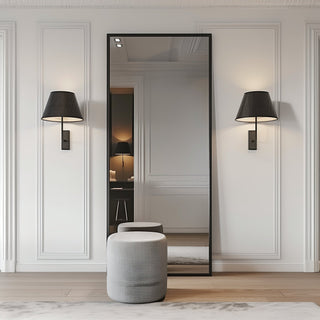
Gabriel Frameless Rectangular Full Length Mirror | 180 x 80cm
No frame, just a clean 180 x 80cm sheet of glass with a polished bevelled edge. With no border to interrupt the reflected light, a frameless mirror like this redirects the most uninterrupted daylight of any style — lean it beside a window and the whole pane goes to work.
$285.00 $355.00 or 4 payments of $71.25 with Afterpay
View Gabriel →Let us be honest about the ceiling on this, because it matters. A mirror cannot increase the total amount of daylight entering your home — only a bigger window or a skylight does that. What a mirror does is redistribute the light you already have, taking it from the bright zone right by the window and relocating it into the shadowed zone where you actually feel the gloom. The total stays the same; the distribution changes dramatically.
The most powerful version of this is the virtual window effect. Optics tells us that a mirror creates an image of whatever sits in front of it, the same distance behind the glass. Hang a large mirror opposite a window and it produces a virtual image of that window, set back behind the wall — so the room reads as if it has a second window pulling in light from the other side. Your eye and your sense of brightness respond to that apparent second aperture, which is why an opposite the window mirror feels so much more effective than the same mirror on a side wall.
Where will you actually notice it? Not next to the window, where it is already bright, but in that dim band a metre or two in — the reading chair, the end of the hallway, the corner of the bedroom that never lifts. That is where a well aimed mirror does its best work, and a windowpane style mirror like the Le Beau leans into the effect by literally looking like the extra window the room wishes it had.

THE VIRTUAL WINDOW
Le Beau Arched Window Full Length Mirror | 190 x 90cm
A slim black metal frame with an arched top and a real windowpane grid, so the reflection reads as an actual second window. Stand it on the wall opposite your real window and it doubles the apparent daylight aperture — the single most effective light trick in this guide.
$445.00 $599.00 or 4 payments of $111.25 with Afterpay
View Le Beau →Placement matters far more than style. These are the positions that work hardest in NZ homes:
The strongest position by a clear margin. The mirror catches incoming daylight and throws it straight back across the room, and it delivers the virtual window effect on top. The closer to the window and the larger the mirror, the stronger the result — even on an overcast Auckland day, the lift is noticeable.
If the opposite wall is taken by furniture or art, an adjacent wall is the next best option. Set the mirror at a slight angle so it picks up the edge of the incoming light and steers it across the room rather than straight back out. This works particularly well in living and dining spaces where the opposite wall is rarely free.
These are usually the darkest spaces in the home, often with no window of their own. A large mirror on the end wall catches borrowed light spilling in from the rooms either side and bounces it down the corridor. The effect is more modest than in a windowed room, but a bright, open hallway sets the tone for the whole house.
Dark alcoves and recessed corners are common in older NZ homes. A frameless mirror leaned into the corner, or fixed on the wall at the end of an alcove, opens the space up and redirects any light that grazes the opening. It is a small change that often feels dramatic in person.

Size does the heavy lifting. The more reflective surface, the more daylight a mirror can redirect, so a full length or oversized wall mirror will always outperform a small decorative piece. On a standard 2.4 metre Kiwi wall, a 180 to 190cm mirror gives you generous reflective area while still leaving a confident gap top and bottom.
Shape matters less than size, but it shapes the feel. Arched mirrors are having a real moment in NZ homes and look striking catching window light, the curve softening an otherwise sharp rectangle of reflection. Round mirrors suit hallways and smaller spaces. And frameless designs, or those with a very slim frame, are the most efficient of all for light — with no border to interrupt the reflected image, the whole pane reads as one continuous sheet of brightness. The arched, frameless Rachelle is a neat example: maximum glass, minimum interruption.

FRAMELESS ARCH — FLOOR LEAN
Rachelle Frameless Arched Floor Mirror | 180 x 80cm
A frameless arched design with a softly rounded top and polished edge. Lean it into a shadowed corner near a window and the large reflective surface pulls daylight into the part of the room that usually stays gloomy. A best seller with 4.94 stars across 195+ reviews.
$285.00 $395.00 or 4 payments of $71.25 with Afterpay
View Rachelle →The first and most common is aiming the mirror at the wrong thing. A mirror reflects whatever sits in front of it — point it at a shadowed wall or a cluttered corner and you simply double the gloom. Give it something bright and worth showing, ideally the window or a light filled part of the room.
The second is going too small. A pretty accent mirror will not shift the light in a genuinely dark room; you need real reflective surface to make a difference. The third is glass quality. Cheaper mirrors can carry a faint green tint or slight distortion that muddies the reflection — clear silver backed glass gives a cleaner, brighter result than heavily antiqued or smoked finishes, which are chosen for mood rather than light. If you want to go deeper on glass, our guide to low iron glass and reflective coatings explains what actually changes the clarity of a reflection.
Mirrors work best alongside other light friendly choices. Pale wall colours — whites, creams and soft greys — reflect rather than absorb the daylight a mirror redirects. Sheer curtains instead of heavy drapes keep the window working through the day. And a well placed floor lamp extends the brightening effect into the evening once natural light fades. A mirror opposite the window by day, paired with a lamp by night, can mean you lean far less on harsh overhead lighting from morning to bedtime.
It is also worth understanding why the same mirror can look brighter or duller in different spots — our piece on why you look different in different mirrors unpacks how light and angle change a reflection, and why some reflections look wavy covers how glass flatness affects the result.
If brightness is the goal, prioritise size and clarity over ornament — a large, clear, simple mirror beats a small decorative one every time, though plenty of mirrors do both beautifully. For wall positions, the wall mirrors collection spans round statement pieces to the windowpane Le Beau. If you have the floor space, a full length mirror offers the greatest reflective surface and works leaned or mounted. For a softer silhouette, browse the arch mirrors or round mirrors ranges.
C&F Creation ships NZ wide via Mainfreight 2Home with live rates calculated at checkout based on your postcode, every mirror carefully packaged and delivered by a two person team to your door. Afterpay and Zip are available on every order.
Do mirrors actually make a room brighter, or do they just look brighter?
Both, in the spots that matter. A mirror cannot manufacture new light — it can only redirect what is already coming through your windows. But because a silvered mirror reflects roughly 90 to 95 percent of the visible light that lands on it, and reflects it directionally rather than scattering it, a well placed mirror genuinely lifts the measured brightness in the shadowed zone a metre or two from the window. So the corner that was dim really is getting more light, not just appearing to.
Where should I place a mirror to get the most natural light?
Directly opposite your main window is the strongest position — the mirror catches incoming daylight and throws it back across the room, and it also creates a virtual image of the window that reads as a second light source. If the opposite wall is taken, an adjacent wall at a slight angle is the next best option. Keep the mirror close to eye level or floor standing; mirrors hung above head height mostly reflect the ceiling and waste the effect.
How big does a mirror need to be to brighten a dark room?
Size is the single biggest lever — the larger the reflective surface, the more daylight it can redirect. A small accent mirror above a mantel looks lovely but shifts almost no light. For a genuinely dark room, a full length or oversized wall mirror (think 160cm tall or more) is what actually moves the needle. On a standard 2.4 metre Kiwi wall, a 180 to 190cm mirror leaves a confident gap top and bottom without crowding.
Are frameless mirrors better for reflecting light?
Slightly, yes. A frameless mirror or one with a very slim frame has no visual border to interrupt the reflected image, so the eye reads a cleaner, more continuous sheet of light. The glass itself does the work in every case, but frameless and slim framed designs like our Gabriel or Rachelle tend to give the most seamless brightening effect. A bold frame is fine too — you just lose a few centimetres of reflective surface to the border.
Does the quality of the glass change how much light a mirror reflects?
A little. Standard silver backed float glass already reflects around 90 to 95 percent of visible light, so most mirrors are very efficient. Cheaper glass can carry a faint green tint or slight surface distortion that dulls the clarity of the reflection rather than the quantity of light. If maximising clean, true light is the goal, clear silvered glass beats bronze, smoked or heavily antiqued finishes, which are chosen for mood rather than brightness.
Will a mirror help a room with no window at all, like a hallway?
Yes, by borrowing light. An internal hallway or windowless landing still receives spill light from the rooms around it. A large mirror on the end wall catches that borrowed daylight and bounces it further down the corridor, which is why hallways feel less like a tunnel once a generous mirror goes in. The gain is more modest than in a room with its own window, but the lift in how open and bright the space feels is real.
Bringing it all together
A mirror is rarely the first thing people reach for to fix a dark room, but the physics makes it one of the most effective tools available — especially in older NZ homes where the architecture never favoured light. The recipe is simple: place it opposite or beside a window, keep it at eye level or floor standing, and go as large as the wall allows. The light was always coming in. A mirror just makes sure it reaches the corner that needed it.
Written by the C&F Creation Team. C&F Creation is NZ owned and NZ designed, ships nationwide via Mainfreight with live rates at checkout, and offers Afterpay and Zip on every order. 4.94 stars across 195+ reviews. Pickup available Westgate Mon–Fri 9am–4:30pm and Sun 9am–12pm (closed Saturdays).