The mid-century floor lamp, done properly
Brass, wood grain and one honest curve: what actually makes a floor lamp mid-century, and three ways the look comes home.

Few looks get asked for more often than mid-century, and few get delivered worse. Somewhere between the furniture reissues and the mustard cushions, the phrase came to mean any lamp with a timber leg. The original idea was better than that, and simpler: warm materials, honest geometry, and light placed where people actually sit.
The designers of the 1950s and 60s pulled light down off the ceiling and handed it to the armchair and the end of the sofa. A floor lamp stopped being a pole with a shade and became a small piece of furniture-scale architecture, with a job to do and no interest in hiding how it did it. That is the standard worth holding the look to now.
Three lamps in our range carry that idea in three different ways. Each begins as a drawing in our Auckland studio and is made at our own factory, and each takes a different route to the same warm end of the room.
The era had rules, even when it looked relaxed. Materials came first — brass, timber tones and fabric led, though chrome kept a seat at the table when it earned one. Forms were drawn with a ruler and one good curve, then left alone. Nothing was ornament for its own sake, and every piece had to earn its footprint.
So when a lamp claims the label, look past it and ask the period's own questions. Would it sit comfortably beside a low timber sideboard, a wool rug, a sofa with legs you can see? Does the shade aim light somewhere useful rather than spraying it everywhere at once? If the answer is yes twice, it belongs.
Mid-century was never a colour scheme. It was a decision about where light should fall.
The gooseneck curve: Aurelia
The Aurelia is the classic of the three. A brass gooseneck arm curves out of a wood-grain pole — a water-transfer print on metal that reads as timber across the room, and we'd rather tell you that than let you find out — holding a cream pleated shade, 34cm across, that softens light through every fold. The pleats are a period detail in their own right: each fold catches the glow on one face and keeps a little shadow on the next, so the shade carries a fine rhythm of bright and dim rather than one flat field of light.
The gooseneck is the practical part. It leans the shade out around 16cm from the pole and tilts it forward, so the light lands on the page of your book or the top of a bedside table instead of pooling beside the lamp. At 156cm tall, with a round brass base 25cm across, it keeps its manners beside an armchair or the end of a sofa. If your room already leans warm, with oak and wool and cream in it, the Aurelia will look like it arrived decades ago and simply stayed.
The bridge arm: Rousseau
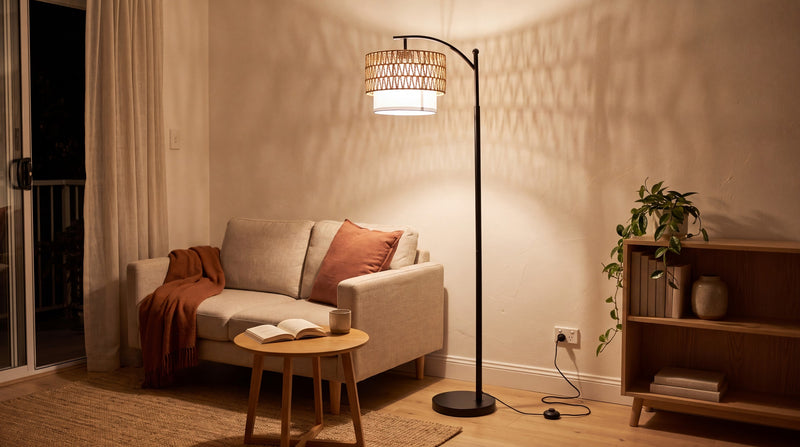
If the Aurelia is the era's polite side, the Rousseau is its relaxed one. It stands 169cm on a matte black pole, and a bridge arm curves over to carry the shade about 26cm sideways. A nudge, not a stretch: enough to clear the arm of a chair and drop light past your shoulder while the base stays tucked beside the seat.
The shade is where the character lives. The outer layer is an open zig-zag weave of twisted paper rope in warm tan, and inside it sits a white linen drum with a light grey trim band. Switch it on and the weave throws a gentle pattern onto nearby walls while the linen keeps the light itself soft and even. From across the room it reads as rattan. Up close it is twisted paper rope, and we would rather tell you than have you find out. It suits the loose end of the look: pale timber, jute underfoot, plants doing well.

The right angle: Marceau
Then there is the modernist end of the era, where the curves gave way to drafting. The arm of the Marceau leaves its pole dead straight, turns once at a sharp right angle, and sets a beige linen drum, 30cm wide and 18cm tall, about 20cm out from the upright. Beside the curvier lamps it looks drawn rather than bent, squared off and almost architectural.
It stands 163.5cm tall on a weighted matte black disc base, and it rewards rooms that already have straight lines going on: black window joinery, square-edged furniture, shelves hung level. Where the Aurelia charms, the Marceau composes. Both are speaking the same language; they just sit at different ends of the sentence.
The three, side by side
| Lamp | Height | The mid-century move | Shade |
|---|---|---|---|
| Aurelia | 156cm | Brass gooseneck cantilevers the shade ~16cm | Cream pleated fabric, 34cm; ~46cm floor all up |
| Marceau | 163.5cm | One right angle, drawn not bent; ~20cm offset | Beige linen drum, 30 × 18cm; ~49.3cm floor all up |
| Rousseau | 169cm | Bridge arm carries the shade ~26cm sideways | Paper-rope weave over white linen |
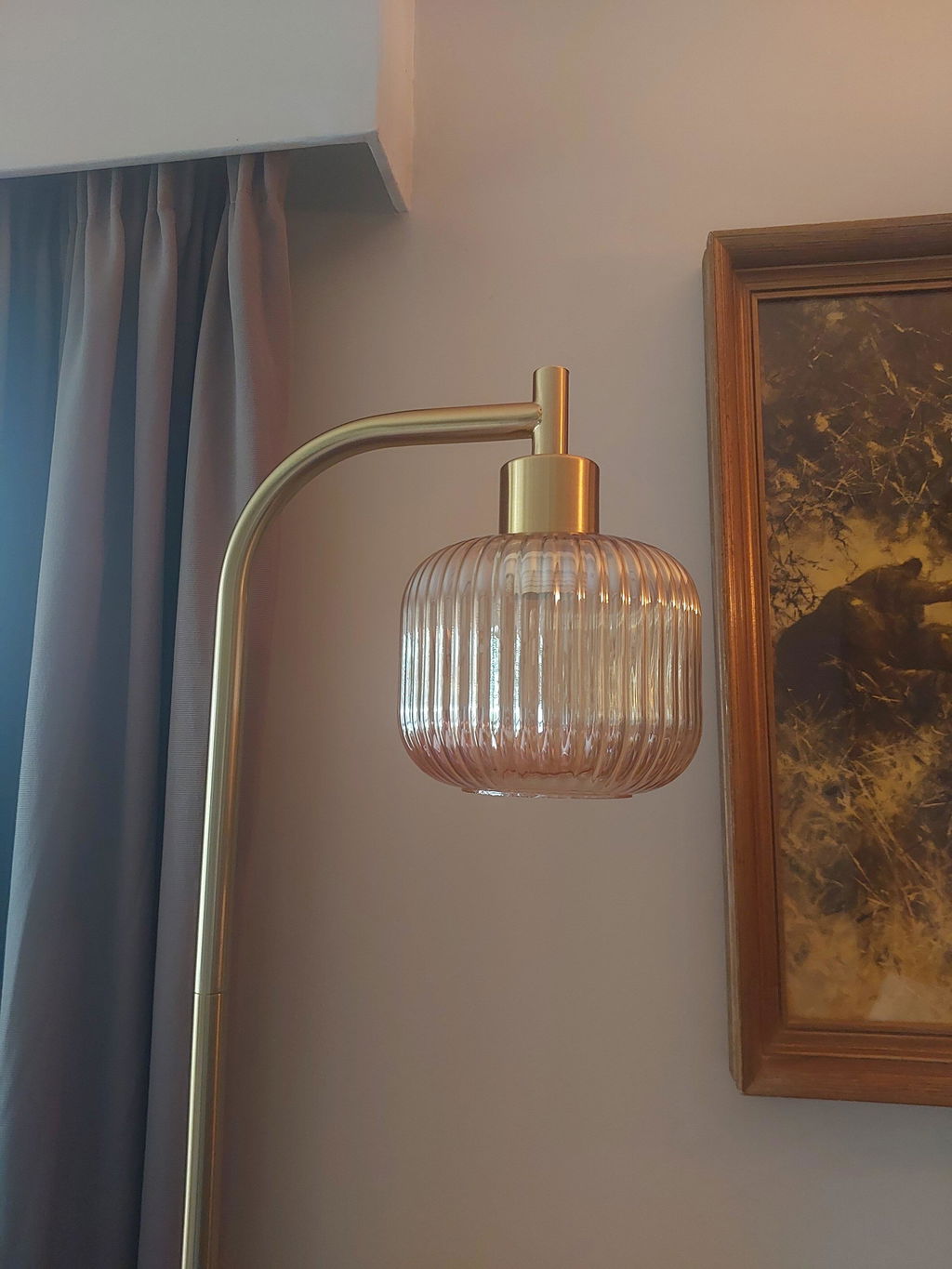
The wider range keeps a foot in the era too: the Orsay's brushed-gold dome and the Solara's fluted glass lantern on its brushed-brass stem both borrow the period's warm metals and honest lines, if the trio above isn't quite your room.
The details that date a fake
Because the label gets borrowed so freely, it helps to know what the era would actually have refused. Not imitation itself — the period loved clever materials — but imitation that lies about it. Plastic sold as linen tends to glow harsher and thinner the moment it's lit; a finish is only a problem when nobody tells you it's a finish, which is why we say plainly that the Rousseau's weave is twisted paper rope and the Aurelia's pole is a print that reads as timber. What the era truly wouldn't sign: ornament with no job, finials and flourishes the light doesn't need, and proportions drawn for a catalogue page rather than a room. The test still works: honest materials honestly described, one good line, light aimed where someone sits.

Choose yours by sentence
“It's for reading, and the room runs warm.” Aurelia — the gooseneck aims the light, the pleats keep it gentle. “The room is squared-off and means it.” Marceau — drafted lines that compose rather than charm. “The room is relaxed, textural, a bit botanical.” Rousseau — the weave throws pattern the room can wear. “I want the era's warmth over the sofa, not beside it.” Step to the arcs and let Orsay's gold dome do the period's work overhead. Floor space rarely decides it — all three tuck beside a seat in under half a metre, the Aurelia at about 46cm all up and the Marceau at about 49.3cm.
Vintage original, or drawn new? A true 1950s survivor is a lovely thing, often still carrying wiring as old as it is. If you go that road, have a licensed electrician look it over before it lives beside your sofa, and check the plug: imported originals weren't drawn with Australian power points in mind. The other road is a lamp drawn new to the era's rules — the geometry and materials of the period, made for Australian power points today — which is the road our three take: they plug straight in, foot switch on the cord, nothing to retrofit. Neither road is wrong. One is a restoration project; the other is light this evening.
Making the look work in an Australian room
None of these lamps wants the middle of the room. Park them beside the seat, not behind it, because all three work by offset: the Aurelia by tilt, the Rousseau by its bridge arm, the Marceau by its right angle. The widest of them uses about 49cm of floor from base edge to shade edge, so they tuck in beside a sofa without asking the furniture to move. Australian living rooms full of pale timber, linen and low sofas are already halfway to the look; the lamp mostly has to not spoil it.
The globe decides the mood, and none comes fitted, so the choice is yours. All three take a standard E27 globe, and warm white, around 2700 kelvin, is the one to buy. Frosted rather than clear keeps the glow even behind fabric. Each lamp runs its cord to an inline foot switch and plugs into an ordinary power point, so there is no electrician involved and nothing a landlord needs to hear about. On a dark July evening in Melbourne, one warm globe behind linen does more for a room than a new sofa would.
If you are weighing up proportions, our guide to how tall a floor lamp should be covers ceiling heights and seated eye lines, and there is a closer look at how these shades treat light in fabric floor lamps and the light they make. The rest of the range, from arcs to glass, sits together in the floor lamp collection, every one drawn in Auckland and made at our own factory.
A few questions, answered
What actually makes a floor lamp mid-century?
Three things the 1950s and 60s insisted on: warm, honest materials — brass, visible timber grain, real fabric; geometry you can read at a glance, a ruler line and one good curve; and light placed for people, tilted or offset toward the seat rather than sprayed at the ceiling. Tick all three and the label is earned, whatever the marketing says.
Do mid-century floor lamps suit a modern minimalist room?
Very naturally — minimalism inherited the same rules about geometry and restraint. The Marceau's drafted right angle reads almost contemporary beside square-edged furniture, while the Aurelia brings warmth into rooms that risk feeling spare. The materials do the bridging: linen and brass soften minimal spaces without cluttering them.
Brass or black for the mid-century look?
Both are period-true, doing different jobs. Brass, like the Aurelia's gooseneck, warms with the light each evening and suits rooms of oak, wool and cream. Matte black, like the Marceau and Rousseau poles, recedes and lets the shade carry the story — the stronger choice where window joinery and shelving already draw dark lines.
Is mid-century style still current for floor lamps?
It has outlasted every look that was meant to replace it, because its rules are practical rather than fashionable: warm light where people sit, geometry a glance can read, materials that don't shout. A well-drawn lamp from this school tends to move house with you long after trendier pieces have gone to the kerb.
Which globe suits a mid-century floor lamp?
A warm white E27 LED around 2700 kelvin, frosted rather than clear. It keeps cream and tan shades looking honeyed instead of grey, and it is standard hardware: all three lamps take an ordinary E27 globe, so replacements are an easy find in any supermarket aisle.
Do these lamps need much floor space?
Less than they appear to. Each stands on a round base about 25cm across, and even the widest, the Marceau, uses roughly 49.3cm measured from the outer edge of its base to the outer edge of its shade. The offset arms mean the light reaches your chair while the lamp itself stays against the wall side of the seat.