Where the floor lamp goes: lighting an Australian lounge room
Four placement zones, real measurements and the lamps drawn for each, from the reading seat to an arc lamp over the sofa: how to light an Australian lounge room from the edges in.

Most Australian lounge rooms are lit by one ceiling fitting that was positioned before the furniture existed. It lights the carpet evenly and the people badly, which is why the room only really works after dark once a floor lamp or two takes over. The question isn't whether a lamp helps. It's where exactly it should stand.
The useful way to think about a lounge room is as four lighting zones: beside the seat, over the sofa, the corner, and the walkway you must keep clear. Each zone has its own rules and its own numbers, and each has lamps drawn for it, from the reading light at the end of the couch to the arc lamp that hangs its shade over the middle seat. Every lamp below starts as a drawing in our Auckland studio and is made at our own factory; the placement thinking comes with it.
Zone one: beside the seat
This is the workhorse position and the natural home of a reading light for the living room: a step to the side of where someone actually sits. In practice, start the base about 30cm out from the sofa's arm and adjust after a sit-down test. The lamp's job is to put usable light onto laps, pages and phone screens without standing in anyone's view of the television or the window.
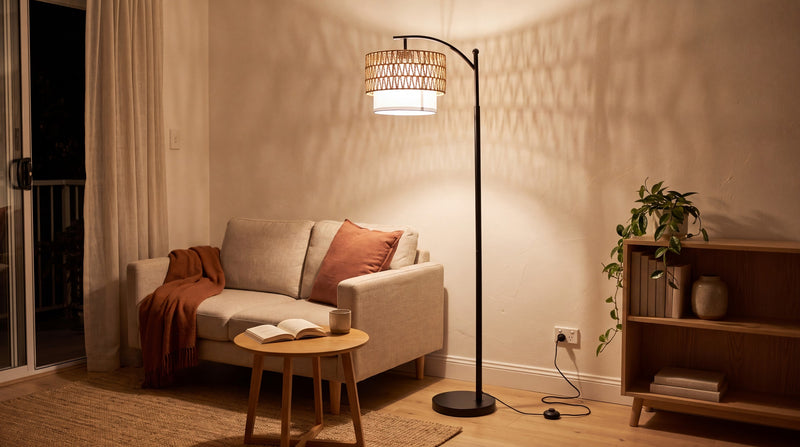
The rules of the zone: park the base level with the sofa's arm rather than behind the backrest, keep the shade's bottom edge near seated eye level, around 105–110cm off the floor, and let the lamp lean toward the seat rather than tower over it. Give the television a thought here too: keep the lamp beside or slightly behind the viewing line, not between the seats and the screen. For output, a reading pool wants around 800 lumens of warm white; if the lamp mostly keeps you company during television, half that is kinder. The Marceau was drawn for exactly this. Its right-angle arm sets a beige linen drum about 20cm out from the pole, nudging light toward the seat while the whole lamp needs only about 49.3cm of floor. The Aurelia plays the same position more softly, tilting its pleated shade forward so the glow falls onto a book, at a compact 156cm. Its own listing calls it an evening lamp rather than a task light, which is exactly how to use it.
Zone two: an arc lamp over the sofa
Plenty of lounge rooms have a sofa that floats: pulled off the wall, facing the television or the view, with nothing overhead but a ceiling fitting in the wrong place. Beside-the-seat lamps light the ends, and the middle seat stays in shade. That middle seat is the problem an arc floor lamp is built to solve in a living room. The base stands behind or just past the sofa arm, the curve climbs and reaches in, and the shade hangs roughly where a pendant would, running from a plug rather than a ceiling rose. You'll also see it sold as an arched or curved floor lamp. The name changes; the reach is what matters, and our arc floor lamp guide covers the shape in full.
Three measurements decide whether your living room suits one. First, a strip of floor beside the sofa for the base, on the wall side and out of the walkway. Second, room for the curve to reach: the Orsay reaches about 46cm from its pole and needs roughly 71.5cm of floor all up, while the Cosmo reaches about 70cm and wants around 102.7cm. Third, the ceiling. Orsay's 173cm sits under a standard 2.4m ceiling with room to spare, but the Cosmo's own listing says its 183cm wants nearer 2.7m to feel proportioned. The Trilogy's three linen shades point down and inward, lighting a roughly 2m span beneath the arc, enough for a two- or three-seater and the coffee table in front of it, yet at 195cm its top shade only just clears a standing adult under 2.4m, so tall households should measure first.
Then place it with tape. Mark the base, mark where the shade will hang, and sit in every seat. The shade belongs above seated eye level and over the seat rather than the walkway; nobody crossing the room should need to duck. Leave about 10cm of air around the curve: clear of the wall, of curtains that get drawn each evening, and of anything on a shelf at shade height. Where the sofa faces a television, sit in the middle seat with the lamp on and check the screen; if the shade shows up in it, slide the base along the sofa until it doesn't. And where the room wants a pendant's worth of shade, the Flore hangs a 40cm linen drum from the tip of its black arc, the kind of drum you'd otherwise have wired into the ceiling.
Zone three: the corner
Every lounge room has a corner the ceiling light never reaches, and it's usually the reason the room feels smaller at night than it does at noon. A lit corner pushes the walls back out.
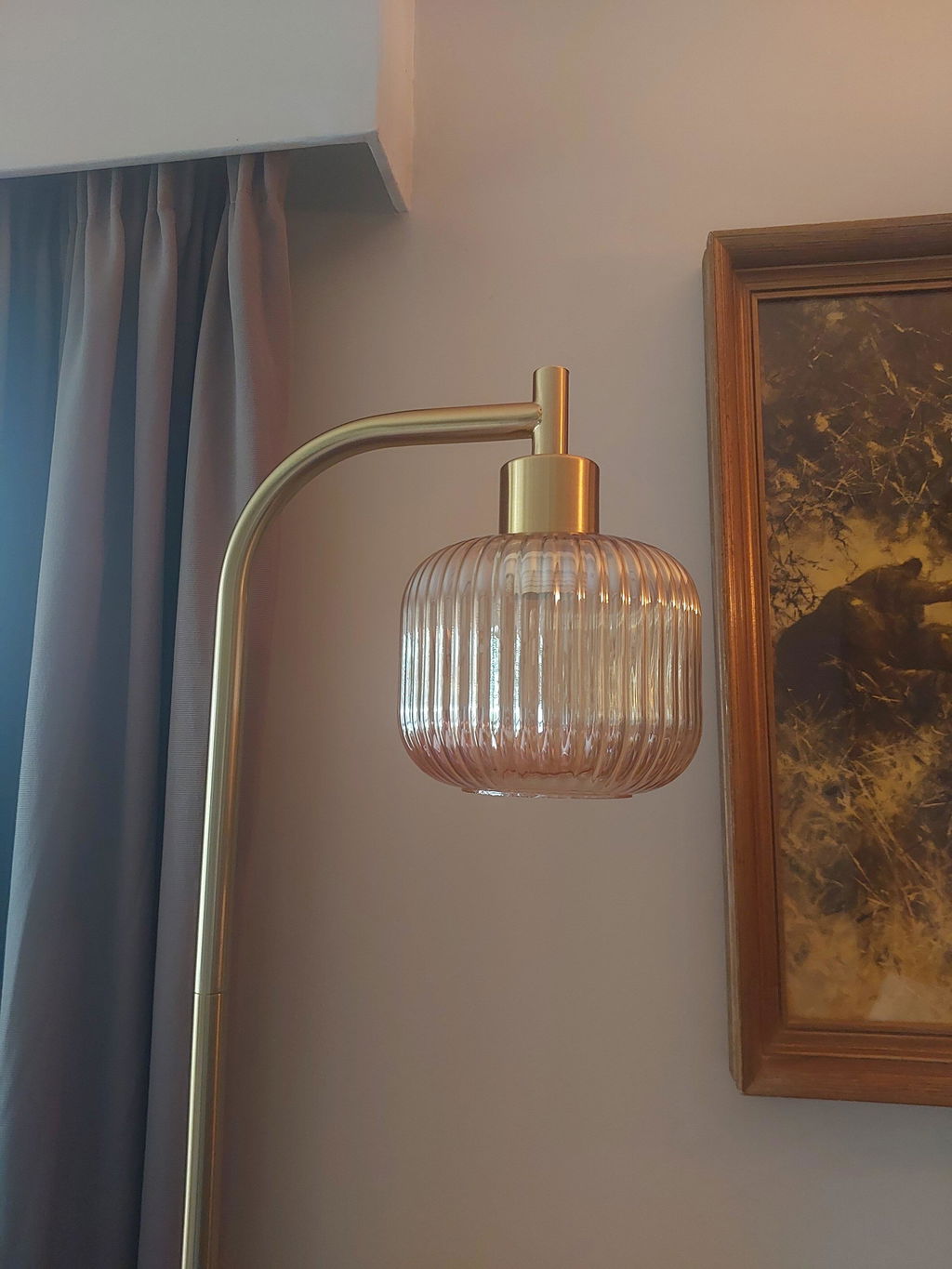
Corners take two kinds of lamp. The first is presence: something worth looking at while it works. The Camille bends its brushed gold pole forward at 173cm to hold a bloom of pressed amber glass, sculpture when it's off and a patterned glow when it's on. The second is coverage for a corner that's genuinely dark: the Voltaire stands 176.1cm with three open cages angled in different directions, filling the corner rather than spotlighting one patch of it. Fit it with three matching filament-style E27 globes (not included) and the globes become the look. And when the corner is barely a corner at all, a sliver between shelving and wall, the Chandelle's 20cm base and glowing linen column were drawn for exactly that gap.

Zone four: the walkway
The fourth zone is the one you keep empty. Every lounge room has a desire line, the path people actually walk from door to sofa to kitchen, and nothing with a cord belongs on it. Two rules keep the room safe and the lamp standing: the base sits on the wall side of furniture, never the traffic side, and the cord runs along the skirting to the power point, never across the path. Check the cord reaches along that route before you settle on a spot; the Marceau, for instance, has a 1.8m cord. A foot switch on the cord, which lamps like the Marceau and Chandelle carry, means the lamp can live in its corner and still switch without anyone reaching behind furniture.
If the household includes small climbers or a large-hearted dog, add two more habits: stand lamps on firm, level floor rather than the edge of a thick rug, and favour designs that carry their weight low. The Vienna and the Cosmo stand on solid marble, the Cosmo weighing 9.7kg assembled on a 32cm base; the Flore carries most of its roughly 6.6kg in a 28cm marble disc; and the Rousseau hides a 2.5kg counterweight inside its base. Weight steadies a lamp against knocks, but nothing makes one climb-proof, so keep little climbers off tall lamps the way you would off a bookcase.
A lounge room isn't lit from the middle. It's lit from the edges, one pool at a time, and the room gathers around the pools.
The zones, and the lamps drawn for them
| Zone | The rule | Lamps drawn for it |
|---|---|---|
| Beside the seat | Base level with the sofa arm; shade bottom near seated eye level (~105–110cm) |
Marceau: 163.5cm, ~20cm offset, ~49.3cm floor Aurelia: 156cm, tilting shade, ~46cm floor |
| Over the sofa | Base behind or past the arm, wall side; measure reach, floor width and ceiling first |
Orsay: 173cm, ~46cm reach, ~71.5cm floor Cosmo: 183cm, ~70cm reach, ~102.7cm floor Flore: 40cm drum hung pendant-style Trilogy: 195cm, 3 shades, ~2m lit span |
| The corner | Presence or coverage; small base if the corner is tight |
Camille: 173cm, amber glass Voltaire: 176.1cm, 3 sockets Chandelle: 20cm base |
| The walkway | Keep it empty; cord along the skirting, base on the wall side | None: this zone stays clear |

Layer the pools, then turn the ceiling off
One lamp rarely finishes a lounge room. The combination that almost always works is one task pool beside the main seat and one ambient glow further away, whether that's a corner lamp or a column like the Chandelle against a far wall. Where the sofa floats in the room, an arc can be the second pool instead, hung over the middle seat. Two pools of warm light at different depths give the room somewhere to look and somewhere to rest, and they flatter it far more than a single bright source. Keep the globes matched, warm white around 2700K in every lamp, so the pools read as one room rather than competing temperatures. Then try an evening with the ceiling light off entirely, and see whether the room feels calmer without it.
If you're choosing the lamps themselves rather than their positions, our floor lamp guide walks the whole decision, and the height guide covers the eye-line arithmetic in detail. The full range stands together in the floor lamp collection.
Place it by sentence
“I read on this end of the sofa every night.” Zone one, Marceau or Aurelia, base level with the arm. “The middle of the couch is a cave.” Zone two, an arc: Orsay if the floor strip is tight, Cosmo if the room can give it about 103cm of floor and a higher ceiling, Flore where a big drum should hang pendant-style, Trilogy for a two- or three-seater and its coffee table under a generous ceiling. “The room dies in that far corner.” Zone three: Camille if the corner deserves an ornament, Voltaire if it needs real light, Chandelle if it's barely a gap. “There's a cord across the rug right now.” Zone four is being broken, so move the base to the wall side and re-run the cord along the skirting. Whichever sentence is yours, a shade beside the seat finishes near seated eye level, a shade over the sofa hangs above it, and in every case the base and cord stay out of the walkway.
A few questions, answered
Where should a floor lamp go in a living room?
One step to the side of where people actually sit, or arcing in from behind the sofa arm if the middle of the sofa needs light. The reliable test is to sit in your usual seat. A shade beside you should finish with its bottom edge near your eye level; an arc's shade should hang above every seated head. Either way, the lamp stays out of the path people walk.
Is an arc floor lamp a good idea in a living room?
It is when the middle of the sofa needs light and there's no pendant wiring above it, which is often the case for renters. The trade-off is space. An arc needs a clear strip of floor for its base, room for the curve to reach, and a ceiling that suits its height. Where the only free spot is a tight corner, a lamp beside the seat is the easier fit.
Which side of the sofa should a floor lamp go on?
The end you actually sit at, on the wall side, and ideally the end nearer a power point so the cord never crosses a walkway. If you write, sketch or do the crossword there, a lamp on the side opposite your writing hand keeps that hand's shadow off the page. Where two people share the sofa each evening, give each end its own lamp rather than stretching one to cover both.
Can a floor lamp go next to the TV?
Yes. A soft lamp beside or slightly behind the screen often makes evening viewing more comfortable, because it narrows the contrast between a bright picture and a dark room. For this job, diffusion matters more than brightness: a fabric shade with a modest warm-white globe works better than an exposed filament, and whatever glows should sit outside your direct line of sight to the picture.
How many floor lamps does a living room need?
Count the zones rather than the square metres. A small room with one seat that matters can carry a single well-placed lamp. Most lounge rooms settle at two, one at the main seat and one further away. Large open-plan rooms often take a third where the dining or kitchen zone begins, so each part of the room has a pool of its own.
Should the floor lamps in a room match?
Not in design. Two different lamps usually look more considered than a matched pair, as long as something ties them together: a shared finish, a repeated shade colour, or heights within the same band. A statement lamp and a quiet one pair well, such as the Camille's amber glass in the corner with a plain linen drum beside the seat.