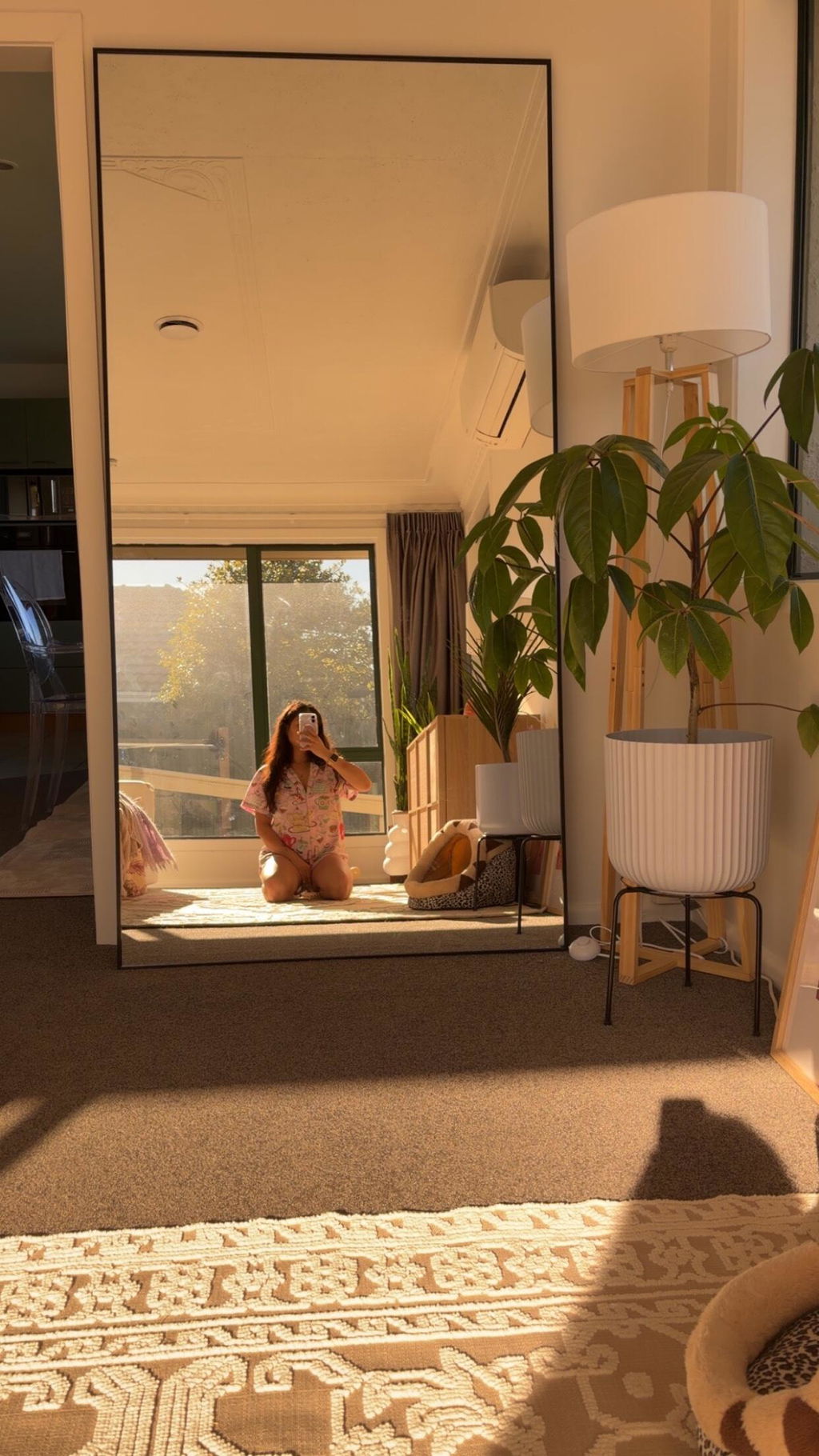
Warm white, explained: the light that makes a room feel like evening
What warm white light actually is, why 2700K is the colour of evening, how linen, glass, gold and an open cage turn the same warm globe into seven different lights, and how to keep a whole house on one colour.

Ask what makes a room feel like evening and most people point at the lamp. They are half right. The lamp decides where the light lands; the globe decides its colour, and that colour is what "warm" means. Every floor lamp we make is drawn in our Auckland studio and made at our own factory, and the globe is not in the box, so, as the Marceau listing puts it, the mood is your call. This is the guide to making a warm white lamp of any of them: what warm white actually is, why the evening wants it, how the same warm globe comes out of linen, glass, gold and an open cage as seven different lights, and how to keep a whole house on one colour. Our E27 globe guide decodes the box; this piece is about the light you live in once the box is in the bin.
What warm light actually is
White light has a colour, measured in kelvin. Low numbers sit at the orange end, high numbers at the blue end. The old incandescent globe most of us grew up under sat at about 2700K, and that is the warm white most listings mean. A candle burns lower still, under 2000K, and the amber filament LEDs that copy it are usually marked 2200K to 2400K. Travel the other way and 3000K is a touch crisper, 4000K is cool white and anything over 5000K is sold as daylight. The E27 guide walks through the box, lumens and the 60W rating.
The number does not say why the low end feels the way it does. Warm light is heavier in the reds and yellows, so it brings those tones out in whatever it touches. Skin looks rested, timber looks like timber, linen glows honey rather than grey. Cool light sharpens edges and lifts whites, which is why it belongs over the kitchen sink and not beside the couch. Neither is wrong; a house that feels right at night has both, each kept to its own job.
Why the evening wants it
Daylight drifts cool and bright, then warm and low as the sun drops. A room lit at 2700K after dark picks up where that left off, so afternoon turns into evening without a jolt; at 4000K the same lounge room reads as a waiting room. Our own listings keep saying so. The Chandelle listing picks a warm white frosted globe and tells you to keep the bright cool whites for the laundry. The Marceau listing picks the same frosted warm white for evenings and saves the cool whites for the home office. The Orsay listing says a warm white filament globe keeps it feeling like evening, even at midday.
So the rule by room is simple. Lounge, bedroom, hallway and the dining table want warm, because those are the rooms you use once the day's work is done. The kitchen bench, laundry, bathroom mirror and a working desk can run cooler; the job there is seeing clearly. The trap is the open-plan room that does both. The fix is not a compromise globe; it is two modes, which we come back to below.
Warm light does not make a room darker. It makes the same brightness feel like evening instead of afternoon.
The shade finishes what the globe starts
Here is the part the box cannot tell you. A 2700K globe is only the beginning; the shade decides how much gets through, in what direction, with what pattern and with what cast of its own. Fit identical warm globes across our range and you get a different evening from each shade. Our fabric floor lamp guide covers the physics of linen properly, so here it is lamp by lamp, in each listing's own words.
Linen first, because it is the gentlest translator. The Chandelle's beige linen column, 16cm wide and 40cm tall, lights up top to bottom as a single vertical line of light rather than a spot. The Marceau's beige drum, 30cm wide and 18cm tall, softens light rather than dropping a hard bright pool of it.
The Rousseau runs two layers, a woven paper rope outer shade in warm tan over a white linen inner drum, so the weave throws warm pattern onto nearby walls while the linen keeps the light soft and even; its listing says go warm white to bring out the tan. The Aurelia's cream pleated cotton cone softens everything that passes through it, warm and indirect with a faint ribbed pattern on the wall behind, an evening-light lamp rather than a task light in its listing's words. In each, the fabric adds its own cast: beige, cream and tan push a warm globe a shade warmer again.
Glass does something different. The Solara shows the globe through a fluted glass lantern about 15cm wide and 15cm tall, and its listing is specific about colour: warm white at 2700K reads most flattering through the fluted glass, and daylight globes look cold here and kill the whole vintage effect. The flutes act as narrow lenses, breaking a warm globe into vertical bands of light on the wall behind and across the ceiling. The Camille's pressed amber glass petals span about 24.5cm over a white diffuser, and its listing puts it in one line: fit a warm white globe and the amber glass turns it into evening light, whatever the hour.

Metal domes work by reflection. The Orsay's gold dome has a white enamel interior that bounces the light down in a soft, wide spread, and its listing explains why the gold matters: chrome can look a bit sharp after dark, while brushed satin gold warms whatever glow comes off the dome. Our gold and brass floor lamp guide covers what each warm metal does with a warm globe. Then there is the Voltaire, which has no shade in the usual sense: three open wire cages with nothing solid between you and the globe. Its listing is blunt that the globes are the look and that ordinary frosted globes will look ordinary. Here the colour of the light is the colour of the globe, full stop. The table below compares the seven lamps whose shade shapes the light; the Orsay sits with the metals in our gold guide.
All seven take a standard E27 globe (the Voltaire takes three), none includes it, and each listing gives 60W as the maximum, which an LED sits well inside. All are 240V plug-in lamps with double insulation, switched at a foot switch on the cable; none dims. Width is the listing's assembled width.
| Lamp | Shade | Globe seen? | The light | Height / width |
|---|---|---|---|---|
| Chandelle | Beige linen column, 16 by 40cm | No | One vertical line of light, not a spot | 166.8cm 20cm |
| Marceau | Beige linen drum, 30cm | No | Soft light, no hard bright pool | 163.5cm 49.3cm |
| Rousseau | Paper rope weave over white linen | No | Warm pattern on the wall, soft even glow | 169cm 48.6cm |
| Aurelia | Cream pleated cotton cone, 34cm | No | Warm and indirect, faint ribbed pattern | 156cm 46cm |
| Solara | Fluted glass lantern, 15cm | Yes | Bands of light on wall and ceiling | 173cm 40cm |
| Camille | Amber petal glass, 24.5cm, white inner | No | Warm glow with pattern, evening light any hour | 173cm 40cm |
| Voltaire | Three open wire cages, 13 by 15cm | Yes, three | Three points of light, three ways | 176.1cm 45cm |
Warm is not the same as dim
Warm light is not low light; they are separate dials. Colour is the kelvin figure, brightness is the lumen figure, and the two sit next to each other on the box so you can set them independently. A 2700K globe can put out 800 lumens for reading under a linen drum or 300 for a hallway glow. The Solara's listing draws the line for you: not a task lamp, a mood lamp that happens to give off 300 to 500 lumens. If you want a warm room you can still read in, keep the kelvin at 2700 and spend the lumens where the page is; our reading floor lamp guide covers where that light should land. Frosted or clear is a third dial, and the shade decides it: frosted behind fabric, filament where the globe is on show, as the Solara, Voltaire and Orsay listings say. Our E27 globe guide has the detail.
The 2200K question
Filament LEDs bring up a number the box lists but few people look for. Amber, vintage-style filament LEDs are often marked 2200K to 2400K, warmer than an old incandescent at about 2700K, though a real candle flame sits lower again, under 2000K. In a glass lantern or an open cage it reads as intended, the glowing coil doing the decorating. Behind beige linen, though, 2200K can tip a room from warm to brown, and it is too orange to read under for long. Our general advice: 2700K for the lamp you live under most nights; 2200K where the globe itself is the ornament, the Solara and the Voltaire in our range, or for a second lamp you switch on last.

Mixing warm and cool in one home
Nobody notices a colour temperature until two of them share a sightline. A 2700K lamp beside a 4000K downlight makes the lamp look orange and the downlight blue, when either alone would look white. So the first rule is one temperature per view, kept by buying a room's globes from the same pack, since two brands' warm whites can sit a visible shade apart once lit. The Voltaire makes the point on its own stand: three globes on one switch, so three matching ones from the same box.
The second rule is for the open-plan room, and it is about hours rather than fittings. Run the kitchen and ceiling lights cool for cooking and cleaning up, then switch them off and let the floor lamps carry the room at 2700K for the rest of the night. Two modes, not one average. Our lounge room placement guide covers where those lamps go; a modern black floor lamp with a linen shade is the usual anchor for the night mode.
The third rule is the bedroom: every globe warm, and the bedside one behind fabric so the glow is even rather than a point. Our bedroom floor lamp guide has the heights and the glare check from the pillow.
Choose by sentence
For an ambient floor lamp used most nights in the lounge or bedroom, fit a frosted warm white at 2700K and put it behind linen for an even glow: the Chandelle, Marceau, Rousseau or Aurelia. If you want visible points of light rather than a glow, choose the Solara or the Voltaire, fit a filament LED and treat 2200K as a second-lamp colour. If you want evening light at any hour without thinking about kelvin again, the Camille's amber glass does the work with a plain warm white inside it. If the room is open-plan with cool downlights, set up a night mode where the lamps take over. Still deciding which lamp at all? Start with our guide to choosing a floor lamp and browse the floor lamp collection with the globe already in mind.
A few questions, answered
Is 2700K too yellow?
Only next to something cooler. On its own, 2700K reads as a familiar warm white, the colour of the incandescent globes homes ran on until LEDs arrived. It looks markedly yellow when a 4000K downlight or a bright phone screen shares the same sightline and hands the eye a cooler reference. Keep one temperature per view and the yellow disappears; 3000K is the next step up if it still feels heavy.
Why does warm white look different during the day?
Because daylight is the reference. Through a window at midday the light runs well above 5000K, so a 2700K lamp switched on beside it reads distinctly orange, then the same globe reads white once the sun has gone and nothing cooler is left to compare it with. The Orsay listing's line about a filament globe keeping it feeling like evening, even at midday, is describing exactly that contrast, used on purpose.
What is the difference between warm white and soft white?
Mostly packaging. "Soft white" is a North American label that usually covers the same 2700K to 3000K band Australian boxes call warm white, and some brands use the two interchangeably. The kelvin figure is the only reliable guide, so read the number and ignore the adjective. Behind linen, 2700K is the figure to look for; 3000K is a little crisper and suits a room used more by day.
Does wall colour change how warm light looks?
Yes, because the wall reflects the light back into the room with its own colour added. Warm whites, clay, terracotta and timber panelling amplify a 2700K globe and the room turns golden. Cool greys and blue-whites pull the other way and can make the same globe look faintly dirty rather than warm, so in a grey room put the lamp behind a beige or cream shade and let the fabric do the warming before the wall does the cooling.
How can I tell what colour temperature a globe already is?
Look at the globe itself. The kelvin figure, or a code such as 827 or 830 where the last two digits mean 2700K or 3000K, is usually printed on the neck or cap (switch off at the power point and let it cool first). If the marking has worn off, hold a known 2700K globe lit beside it: a visibly yellower or whiter neighbour tells you which way it leans, and that it should move to another room.
Can I mix filament and frosted globes in one room?
Yes, if they share a colour temperature. A 2700K filament globe in the Solara and a 2700K frosted globe behind the Chandelle's linen read as one warm room with two textures of light, which is a good pairing. The trouble starts when the filament globe is a 2200K amber type and the frosted one is 2700K or 3000K; then the amber lamp looks orange and the other looks pale. Check both boxes before you buy.