Listen to this guide

It happens on the first dark scene. The room is lit the way you wanted it, the lamp is on beside the sofa, and there in the lower corner of the television is a second lamp, floating in the black, brighter than anything in the picture. You shuffle along the sofa and it slides across. You dim the lamp and it fades a little. Then a bright scene comes and you forget about it, until the next dark one.
A television is a mirror with a picture painted on it. Whenever the picture goes dark the mirror is what you see, and at night the brightest thing in a living room is the lamp. The fix is rarely a different lamp. It is a different spot for the one you have, found by a rule that takes two minutes to apply. This guide explains the rule, gives you two tests you can do tonight without moving a single piece of furniture, and works the numbers for every floor lamp in our range, so you know before you buy which ones show up in the glass as a hard dot and which as a soft haze.
The short version. The screen reflects whatever sits at the matching angle on your side of the room. Stand at the television and look back: whatever is glowing from there is what the screen will show you from the sofa, and roughly where.
Sideways beats height. From a sofa 3 m back with the lamp beside you, every lamp we sell lands its reflection between about 1.2 and 1.4 m up the screen, which is inside a wall mounted screen whatever you do with the height. Moving the lamp 30 cm sideways moves the reflection 15 to 26 cm, and that is what takes it off the glass.
Soft sources forgive, bare globes do not. A linen drum spreads its light over about 700 square cm; a bare globe over about 30. Same lumens, fifteen times the brightness in the glass.
Why the lamp ends up in the screen
Glass reflects a few percent of the light that hits it, and it reflects it the way a mirror does: the angle in equals the angle out. The useful way to picture that is the mirror image. Whatever stands in front of a mirror appears to stand the same distance behind it, and your eye sees it along a straight line to that image. A television does exactly this, it is just that most of the time the picture is bright enough to drown the reflection. In a dark scene the picture steps aside and the room appears in the glass, with the lamp as its brightest point.
So the lamp's reflection sits where the straight line from your eye to the lamp's mirror image crosses the screen. Two things follow from that, and they are the whole of this guide. First, a lamp beside the sofa is as far from the screen as you are, so its image sits as far behind the glass as you sit in front: the reflection lands halfway between your eye and the lamp, in height and in sideways distance alike. Second, a lamp near the television is close to the glass, so its image is close behind it, and the reflection moves almost one for one with the lamp. The fraction that does the work is your distance to the screen divided by your distance plus the lamp's: one half for a lamp beside you, two thirds for one halfway across the room, about six sevenths for one standing just in front of the television wall.
The same rule runs sideways. A lamp 90 cm to the left of your line to the screen, standing beside you, appears 45 cm to the left of the screen's centre; the half width of a 55 inch screen is 61 cm, so it is in the picture. Move the lamp out to 130 cm and the reflection sits at 65 cm, just off the edge. That is the whole mechanism, and the two tests below are two ways of finding it in your own room without a tape measure.
Test one: stand where the television is
- Sit where you watch, with the lamp on and the room lit the way it is at night. Note where the lamp shows in the dark screen, if it does. Then get up.
- Walk to the television and stand with your back to it, in the middle of the screen, and crouch until your eyes are level with the screen's centre. That is about 1 m off the floor for a screen on a unit, 1.2 m for one on the wall. Look back at the room.
- Whatever is glowing in front of you from there is what the screen shows the sofa. Not the lamp as you see it from your seat: the lamp as the screen sees it. A down facing dome shows you its dull outside. A drum or a column shows you its whole lit side. A bare globe shows you itself. Things on your right as you stand at the screen will be on the left of the picture from the sofa, because the mirror swaps them back.
- If you want a record, put your phone where your eyes were, camera facing the sofa, and take the photo. Give or take the dimming of the glass, that photo is the reflection the sofa gets. It also tells you how big the reflection will be: a lamp that fills a tenth of the frame from the screen's spot fills about a tenth of the screen from the sofa.
This test is why the shade matters more than the lamp's height. From the screen's position you are looking slightly up at a floor lamp, from a metre or so off the floor to a glow at a metre and a half. A dome that points down at a chair shows that viewpoint its back; a drum shows it a glowing cylinder; a cage shows it three globes with nothing in the way. The lamp has not changed, only what the screen can see of it.
Test two: move the lamp 30 cm sideways
Back on the sofa, with the lamp still showing, move it 30 cm further from the centreline of the seat you watch from and look again. The reflection moves, but not by 30 cm, and how far it moves tells you where the lamp stands in the geometry:
| Where the lamp stands | Lamp to screen | How far the reflection moves when the lamp moves 30 cm | How far from the centreline the lamp can stand before it leaves a 55 inch screen |
|---|---|---|---|
| Beside the television, a little in front of it | about 0.5 m | 26 cm | 71 cm |
| Halfway across the room | about 1.5 m | 20 cm | 91 cm |
| Beside the sofa | about 3 m, the same as you | 15 cm | 122 cm |
| Behind the sofa | about 3.5 m | 14 cm | 132 cm |
Computed for a 55 inch widescreen television, 122 cm wide, with the viewer seated 3 m from it. The last column is the screen's half width divided by the fraction for that position: a lamp closer to the screen than that distance, measured from the viewer's line to the screen, is in the picture.
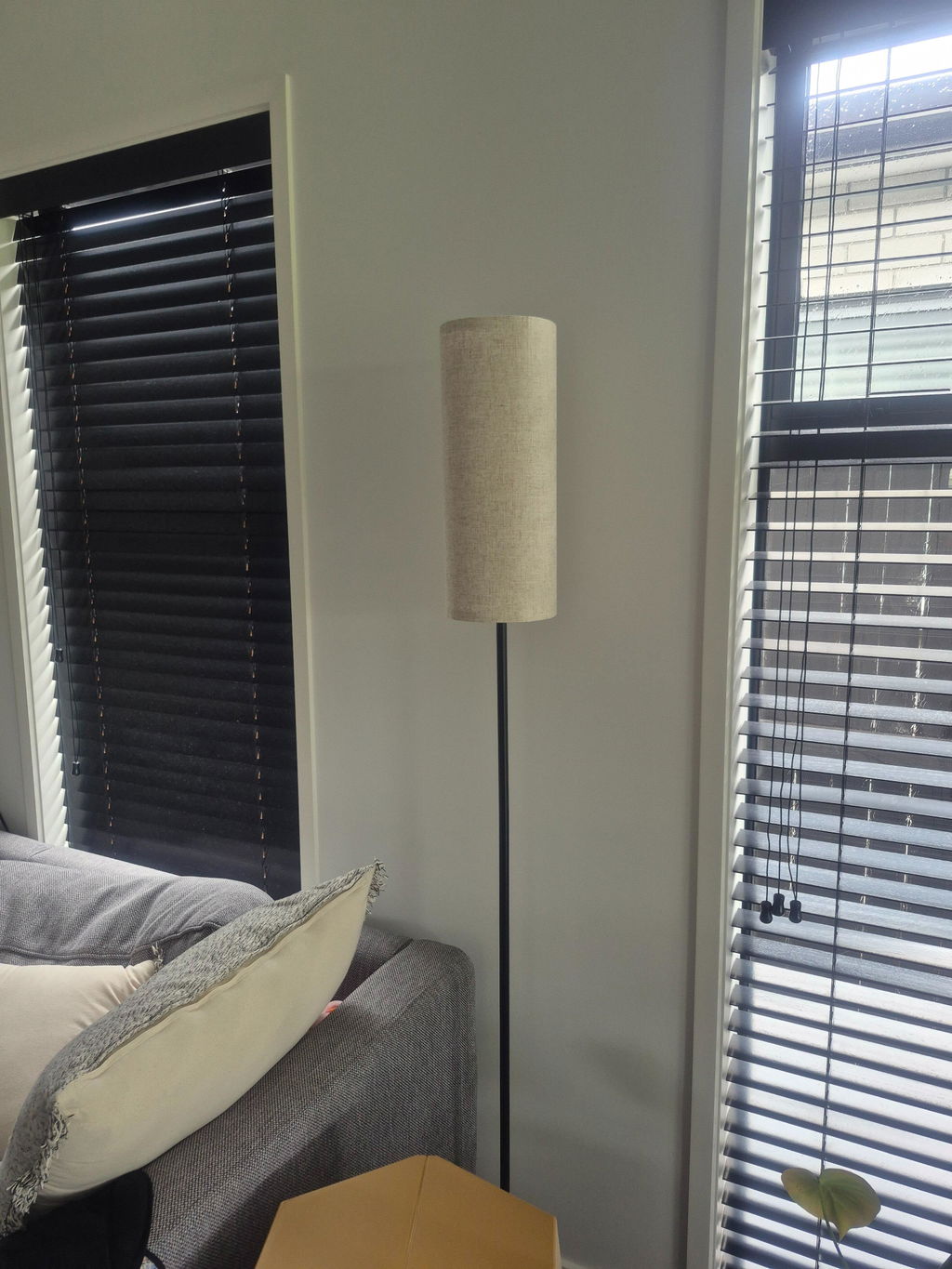
Read the last column against your sofa. A three seater is about 2.2 m wide, so from the middle seat its arms are 110 cm out, and a lamp hard against the arm stands about 125 cm from your line to the screen: at the edge of a 55 inch picture, a few centimetres either way. Push it 30 cm past the arm and it is clear by about 15 cm. A two seater is 1.6 to 1.8 m wide, which puts a lamp at its arm 90 to 100 cm out and squarely in the picture; it wants to stand 40 cm past the arm, or behind the sofa's back corner, where the fraction drops and the limit widens to about 130 cm. The hero photo at the top is the three seater case: the Rousseau is about 130 cm out, and the dark screen is clear of it.
A lamp on the television wall, beside the unit, is the easy case. Standing at nearly the screen's depth its reflection moves almost one for one, and to show in the glass it would have to stand within about 70 cm of the centreline, and the television and its unit are already standing there. What it does instead is light the wall behind the screen, which is a help in its own right: a lit surround makes a dark scene look less like a mirror, and the eye forgives small reflections it would otherwise hunt. The placement guide covers where a lamp on the television wall earns its keep in the rest of the room; this guide is only about the glass.
Height does less than you think
The instinct is to fix a reflection by raising the shade above the screen, or by choosing a taller lamp. The geometry says that moves the reflection up by half the change, for a lamp beside you: 20 cm taller, 10 cm higher in the glass. We worked it for every lamp in the range. The glow heights of five lamps, the Rousseau, Orsay, Voltaire, Cosmo and Aurelia, were scaled off their white background product photographs against the listed overall height; the other eight were estimated from their listed height and shade size.
| Lamp | What the screen sees | Glow, cm off the floor | Reflection beside the sofa | Inside a screen centred at 1.0 m / 1.2 m | Brightness in the glass (Rousseau = 1) | Today |
|---|---|---|---|---|---|---|
| Rousseau Rattan Weave | diffused linen drum behind an open rope band: a soft patch the size of the drum, dim per square centimetre | 135 to 164 | 130 cm | yes / yes | 1 | In stock |
| Orsay Gold Arc | down facing brushed gold dome, white inside: the dull gold outside of the dome; bright only if the dome is tilted toward the screen | 142 to 164 | 128 cm | yes / yes | 1.5 | In stock |
| Voltaire 3 Light Cage | three bare globes in open wire cages: three small hard points of light; the brightest class | 118 to 156 | 124 cm | yes / yes | 15 | In stock |
| Cosmo Chrome Marble Base | down facing polished chrome dome, white inside: the chrome outside mirrors whatever is bright in the room, so a small sharp highlight | 131 to 161 | 124 cm | yes / yes | 1 | In stock |
| Aurelia Pleated Fabric | tilted pleated cotton cone: a soft glowing cone; the pleats break the patch up | 126 to 152 | 124 cm | yes / yes | 1.6 | In stock |
| Chandelle Linen Column | tall linen column: a tall soft column of light, dim per square centimetre | 125 to 165 (est.) | 128 cm | yes / yes | 1.1 | In stock |
| Marceau Linen Drum | linen drum on a down bridge arm: a soft patch like the Rousseau | 140 to 158 (est.) | 130 cm | yes / yes | 1.4 | In stock |
| Vienna Brass Marble Base | tapered slub linen shade: a soft patch | 143 to 166 (est.) | 132 cm | yes / yes | 1.3 | In stock |
| Solara Fluted Lantern | bare globe behind clear fluted glass: a hard point of light, with the Voltaire in the brightest class | 155 to 173 (est.) | 137 cm | just above the top edge / yes | 12 | In stock |
| Camille Amber Petal Glass | amber glass petal shade with a white diffuser, down bridge: a warm amber glow, medium | 150 to 170 (est.) | 135 cm | just above the top edge / yes | 3 | In stock |
| Saturne Black Globe Arc | matte black metal globe open at the bottom, white inside, on an arc: the matte black outside: the quietest shape from the screen side unless the opening faces the screen | 160 to 185 (est.) | 141 cm | just above the top edge / yes | 1.7 | In stock |
| Flore Black Arc | large white linen drum on an arc: a large soft patch, high up | 160 to 185 (est.) | 141 cm | just above the top edge / yes | 0.8 | In stock |
| Trilogy 3 Light | three slub linen drums on three arcs: three soft patches at three heights | 150 to 185 (est.) | 139 cm | just above the top edge / yes | 3.1 | In stock |
Reflection height assumes a seated eye at 1.1 m and a sofa 3 m from the screen with the lamp beside it (fraction one half). A 55 inch screen spans 0.66 to 1.34 m when its centre is at 1.0 m, on a 50 cm unit, and 0.86 to 1.54 m when wall mounted with its centre at 1.2 m. Brightness in the glass is the lamp's typical lumens divided by the area of its glowing face as the screen sees it, relative to the Rousseau drum; it is arithmetic on the listed dimensions, not a meter reading. "Est." rows are estimates from the listed height and shade size and will be re measured against the landed stock.
Two things stand out. On a screen sitting on a unit, the five lamps with the lowest glow all land inside the picture, and the tall arcs clear its top edge by somewhere between 1 and 7 cm, which is less than the difference between slouching and sitting up. Wall mount the same screen at 1.2 m and every lamp in the range lands inside it. Height, in other words, is not a lever you can pull far enough. Sideways is. Our sizing guide is the place to choose a lamp's height; choose it for the room and the ceiling, not for the television, because the television will not notice.
What kind of light reflects worst
Glass sends back only a few percent of what hits it, so what you see in the screen is a dimmed copy of the lamp's surface, and the thing that decides whether the copy is a hard dot or a faint haze is how bright that surface is per square centimetre. A bare globe pushes all of its lumens out of a few dozen square centimetres of glass. A linen drum takes the same lumens and spreads them across seven hundred. The drum's reflection is a wide, soft patch you can read a face through; the globe's is a small, hard point that the eye goes straight to, the way it goes to a car's headlight on a wet road.


That is the order of the range, from quietest to loudest in the glass. The diffused shades, the Rousseau drum, the Chandelle column, the Marceau and Flore drums, the Vienna taper and the Aurelia cone, all sit within a factor of two of each other: soft patches, forgiving of a bad position. The Camille's amber glass is about three times the Rousseau, a warm glow rather than a point. The three small drums of the Trilogy are about three times too, because the same light is spread across less linen. Then there is a gap, and the two bare globe lamps: the Solara, a globe behind clear fluted glass, about twelve times; the Voltaire, three globes in open cages, about fifteen. Those two are lamps for the look of the globe, and they want to live outside the picture's limit.
The domes are a case of their own, because a dome faces down and the screen looks at it from the side. What the screen sees is the outside of the shade, not the light. The Orsay's brushed gold outside is dull; from the screen's side it reads as a warm shape, not a lamp, as long as its pivot points the opening at the chair and not at the television. The Cosmo's outside is polished chrome, which is itself a mirror, so the screen sees a miniature of whatever the dome is reflecting: the pool of light on the floor beneath it, a window by day, the television by night. That is a small, sharp highlight rather than a glow. Some people will never notice it; some will not be able to stop. The Saturne is the quiet extreme, a matte black globe open only at the bottom, which shows the screen nothing but a dark shape unless the opening faces it.
Matte screens and curved ones. An anti glare screen does not remove a reflection, it smears it: a bare globe's hard dot becomes a grey smudge the size of your hand, which is easier to ignore in a bright scene and harder in a dark one. A glossy screen keeps the reflection small and sharp and otherwise shows the same thing. The sideways move works on both. A curved screen gathers reflections from a wider sweep of the room, so treat its limits as a little narrower than the table above.
Arc lamps over the sofa. An arc that reaches over the middle of the sofa puts its shade in the middle of the picture by geometry: the source is behind your head and on your line to the screen, so its reflection lands dead centre, about 1.25 m up. What saves it is that the dome faces down and the screen sees its outside. Brushed gold is quiet there; chrome shows a highlight. If you are the kind of person who will see it, swing the arc to one side of the sofa rather than over its middle, and read the arc reach guide for how far each of ours reaches.

Our range, lamp by lamp
Every lamp in the table is in stock today, and four of them are carded below. The table covers all thirteen because the geometry depends on the shade, and because the honest answer for a few of them is that they belong outside the picture.


Rousseau Rattan Weave Floor Lamp
169 cm tall, with the drum glowing between 135 and 164 cm. About 725 square cm of linen behind the rope, the softest surface of the four carded here: if a lamp has to sit inside the picture, this is the one that reads as a haze rather than a lamp. Beside the arm of a three seater it clears a 55 inch screen with a few centimetres to spare.

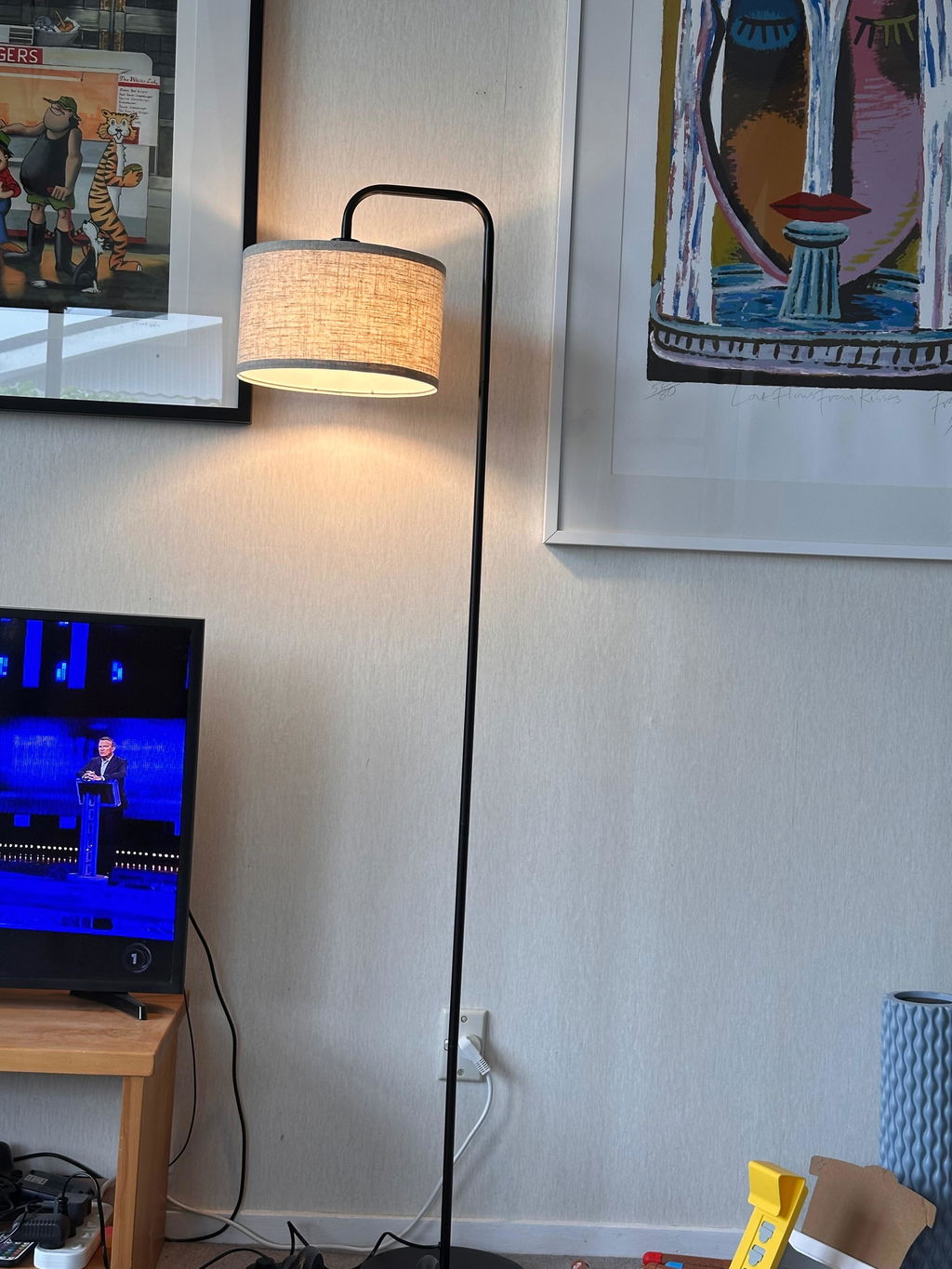
173 cm tall, the dome between 142 and 164 cm at the end of a 70 cm arc. The dome faces down, so the screen sees brushed gold, not light. Point the pivot at the chair and never at the television, and let the arc do the work: the base stands outside the limit while the light lands where you read.

Voltaire 3 Light Cage Floor Lamp
176 cm tall, three bare globes between 118 and 156 cm. The plain warning in the range: three hard points at about fifteen times the surface brightness of a drum. Keep it past the lateral limit, on the television wall or behind the line of the sofa, and run it on low lumen filament globes. It is a lamp for the look of the globe, not for sitting in the picture.

Cosmo Chrome Marble Base Floor Lamp
183 cm tall, the chrome dome between 131 and 161 cm on a metre of arc. The outside of the dome is a mirror, so the screen sees a highlight of whatever the chrome reflects rather than a glow. Over the middle of the sofa that highlight sits in the middle of the picture; swung to the side of the sofa it leaves the glass.
If it still shows
- Move the seat, not the lamp. The rule works the other way round. Shifting your head 30 cm along the sofa moves the reflection the opposite way, by the remaining fraction: 15 cm for a lamp beside you. Two people on a three seater will not both be clear of a lamp that is marginal for one of them, so position it for the seat that watches most.
- Dim it, or change the globe. A reflection is the lamp's surface brightness dimmed by the glass; halve the lumens and you halve the reflection. A 400 lumen warm globe instead of an 800 does it; so does a dimmer. Our globe guide has the warm end of the range and what each lamp takes.
- Turn the opening away. The Orsay's pivot and the Aurelia's gooseneck both let you point the shade's opening at the chair, so the screen sees the back of the shade. On a drum there is nothing to turn, which is why the drum's answer is position.
- Light the wall behind the screen. A soft lamp behind or beside the television raises the brightness of what surrounds the screen, and a reflection the eye could pick out of a black surround vanishes against a lit one. The lamp on the television wall is also the one that cannot reflect, so it earns its place twice. The corner lamp guide covers the dark corner behind most televisions.
- Remember the window. By day the biggest thing in the glass is not a lamp but the window behind the sofa, two square metres of sky at the same geometry. A curtain fixes that one, and a lamp that has been placed by this rule is already clear of it by night.
The limits of this guide
The rule is the plane mirror rule and the screen is treated as a vertical sheet of glass; a curved screen, a screen tilted down on its bracket, or a seat well off the centreline changes the numbers, though not the method. The seated eye at 1.1 m, the 3 m viewing distance and the 55 inch screen are assumptions you should swap for your own; the fraction and the limit come straight from the two distances. Glow heights without an est. mark are scaled off product photographs, not measured with a tape, and are good to about 3 cm; the est. rows are estimated from their listed dimensions. The brightness column is arithmetic on areas for a typical globe, not a measurement with a meter, and it says nothing about colour or about how any of these lamps looks when you are not watching television. For that, the living room lamps guide is the one to read.
Frequently asked questions
Why does my floor lamp show up in the TV screen?
Because the screen is glass, and glass reflects a few percent of what hits it the way a mirror does. When the picture is bright you do not notice; in a dark scene the reflection is what is left, and the lamp is the brightest thing in the room. The reflection sits where the straight line from your eye to the lamp's mirror image, as far behind the screen as the lamp is in front, crosses the glass. Move the lamp sideways and that crossing point moves off the screen.
Where should a floor lamp go so it does not reflect in the TV?
Either on the television wall beside the unit, where it cannot reach the picture, or beside the sofa far enough from your line to the screen: for a 55 inch screen and a sofa 3 m back, about 1.2 m from the middle seat's centreline, which is 30 cm past the arm of a three seater. Behind the sofa's back corner the limit widens to about 1.3 m. Stand at the television and look back to check: whatever glows from there is in the picture.
Does a matte or anti glare TV screen stop lamp reflections?
No, it spreads them. A matte coating turns a bare globe's hard dot into a soft grey smudge about the size of a hand, which is easier to ignore in a bright scene and harder in a dark one. A glossy screen shows the same lamp as a small sharp point. On both, moving the lamp sideways is what removes it, and a diffused shade is what makes whatever is left gentle.
Does a taller floor lamp reflect less in the TV?
Barely. For a lamp beside the sofa the reflection climbs by half of any change in the lamp's height, so a lamp 20 cm taller moves its reflection 10 cm up the glass. Every floor lamp in our range, from 156 to 196 cm tall, lands its reflection between about 1.2 and 1.4 m up the screen plane from a sofa 3 m back, which is inside a wall mounted screen. Choose the lamp's height for the room; move it sideways for the television.
Is a lamp beside the TV or beside the sofa better for reflections?
Beside the television is the safe position: at nearly the screen's own depth the lamp would have to stand within about 70 cm of the centreline to show in it, and the television and its unit are already there. Beside the sofa works too, but only past the lateral limit, about 1.2 m from your line to the screen for a 55 inch set at 3 m. The one position that always fails is halfway across the room within a metre of the centreline, which is where a lamp beside a coffee table usually ends up.
What kind of lamp shade reflects least in a screen?
A diffused fabric shade, a linen drum, a column or a pleated cone, because it spreads the globe's light across several hundred square centimetres and the reflection becomes a faint patch rather than a point. A down facing opaque dome is quieter still from the screen's side, since the screen sees only the outside of the shade, unless that outside is polished chrome, which mirrors whatever is bright. Bare globes in cages or clear glass reflect hardest: the same lumens from a few dozen square centimetres, about fifteen times the surface brightness of a drum.
Choosing a lamp for the television room?
Browse our floor lamps, each with its height, shade dimensions and globe fitting on the product page, and the arc lamps if you want the light over the seat with the base out of the picture. Lamps are couriered NZ wide at the live rate shown before you pay, or collect from our Albany showroom at Unit B, 19 Arrenway Drive, Rosedale, open seven days. Lamps never need freight: Mainfreight carries our large mirrors, not these. Afterpay and Zip available. NZ designed, NZ owned, rated 4.9 stars from over 200 reviews across our range.
Written by the C&F Creation Team. Figures: the overall height, width and shade dimensions listed on each of our floor lamp product pages, the white background product photographs scaled against those heights, and the plane mirror arithmetic set out in the text, taken together on 29 October 2026.